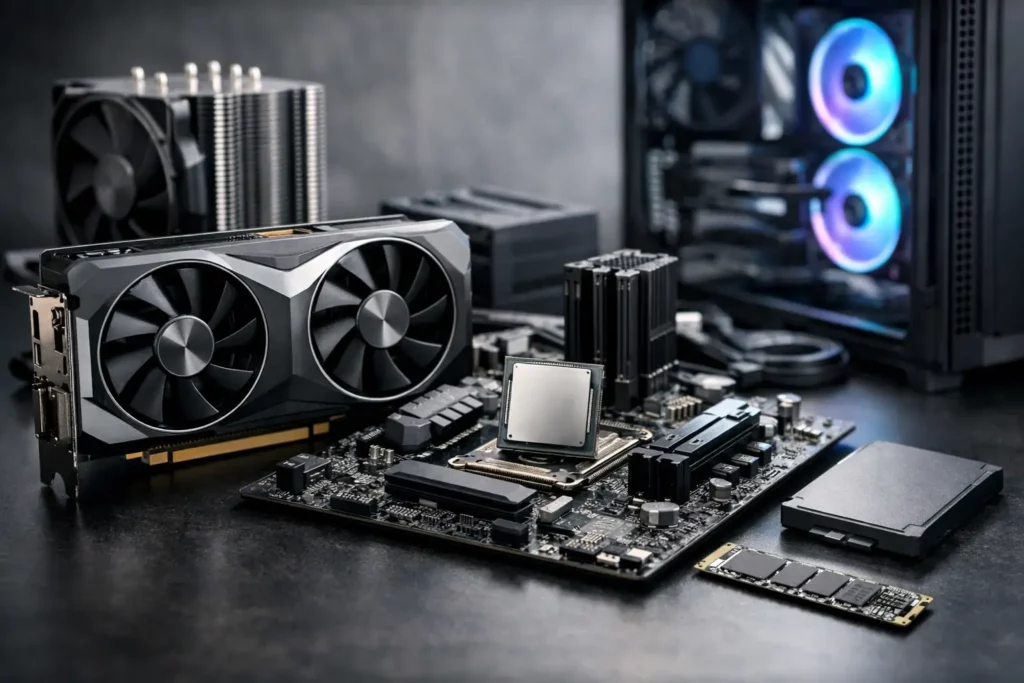
A flashy keynote, a benchmark slide with tiny fine print, and a launch date that somehow means “good luck finding stock” – that is still the rhythm of pc hardware launch news in 2026. If you follow every GPU tease, CPU refresh, SSD speed claim, and monitor reveal, you already know the cycle. The hard part is figuring out which launches actually change your upgrade plans and which ones are just noise for the feed.
That matters more now because PC buying has gotten weirdly fragmented. A gaming setup is no longer just a graphics card and a processor. It is also high-refresh OLED panels, PCIe 5.0 storage, USB4 docks, Wi-Fi 7 motherboards, AI-branded laptops, quieter coolers, and a growing stack of accessories that all want a piece of your budget. Launch season is exciting, but it can also push people into paying early-adopter prices for features they will barely use.
Why pc hardware launch news hits differently now
A few years ago, launch coverage mostly revolved around obvious tentpole products. New flagship GPUs. New desktop CPUs. Maybe a laptop platform shift that clearly moved the market forward. Now, the news cycle is broader and much faster. Brands are announcing niche SKUs, mid-cycle refreshes, regional variants, and software features as if each one is a major hardware event.
For readers, that creates a real gap between what is new and what is useful. A launch can be technically impressive and still not be the right buy. A card with higher frame rates may also pull more power, cost more than expected, and land in a market where last-gen discounts make better sense. A new gaming laptop might promise AI workloads and battery gains, but if thermals are shaky or pricing climbs too high, the practical value starts to wobble.
That is why the best pc hardware launch news is not just about specs. It is about context. What is improving? What is staying expensive? What is getting replaced? And what can you safely ignore for another six months?
The launches that move the market
GPUs still set the tone
Graphics card launches remain the biggest attention magnets for a reason. They touch gamers, creators, streamers, and anyone trying to stretch an aging rig another year. When a new GPU line lands, it does more than introduce fresh performance tiers. It also reshapes pricing on the cards already sitting at retail.
That is usually where the real story lives. A new flagship is fun to watch, but midrange movement tends to matter more. If a launch pushes older cards into meaningful discounts, that can be a bigger win for most buyers than the new product itself. It depends on performance per dollar, power draw, feature support, and whether supply stays stable after day one.
There is also a growing split between raw gaming performance and feature-driven value. Upscaling, frame generation, creator tools, AV1 support, and AI software stacks now factor into launch reactions almost as much as raster benchmarks. If you only play esports titles at 1080p, you may care far less about those extras than someone editing video or chasing 4K ray tracing.
CPU launches are more about platform value
Desktop CPU announcements still matter, but the headline numbers do not always tell the full story. A faster chip is great, but motherboard pricing, memory requirements, cooler compatibility, and platform longevity often decide whether a launch is actually compelling.
That is why some CPU launches feel bigger after the reviews than they do during the reveal. If a new processor drops into an existing board with a simple BIOS update, interest tends to spike. If it demands a pricier motherboard, faster RAM, and better cooling, the upgrade path gets narrower fast.
For gaming-focused readers, the difference between “best overall” and “best value” keeps getting sharper. Some chips are clearly tuned for top-end frame rates. Others make more sense as balanced picks for gaming, work, and everyday use. Launch coverage that skips that distinction misses what buyers actually need.
SSDs, monitors, and peripherals are no longer side stories
Storage launches used to be easy to skim. Higher speeds, lower prices, move on. Not anymore. With modern game installs ballooning and direct-storage style conversations continuing to shape expectations, SSD news now hits both performance and convenience.
Still, not every faster drive changes the experience in a way most people will notice. For many buyers, capacity, thermals, sustained performance, and price per gigabyte matter more than headline sequential numbers. A new PCIe 5.0 model may look impressive on paper, but a solid PCIe 4.0 drive can remain the smarter buy.
Monitors are in a similar place. OLED has changed the conversation, but launch excitement can hide trade-offs. Burn-in concerns have improved, not vanished. Brightness behavior varies. Text clarity still depends on panel choices. A new ultrawide might look like a dream setup for gaming and work, but desk space, GPU requirements, and pricing can turn it into a niche product very quickly.
How to read launch coverage without getting sold on hype
The fastest news hits are useful for catching the announcement, but they should not be the final word. At launch, brands are controlling the narrative. They choose the charts, the comparisons, and the language. That does not automatically mean the product is bad. It just means the first wave of information is designed to make the release look as strong as possible.
The smartest way to read launch news is to treat the first announcement as a signal, not a verdict. Price is provisional until retail settles. Performance claims need independent testing. Features sound better when they are listed than when they are actually used day to day.
This is where a little restraint pays off. If a product solves a specific pain point for your setup, an early purchase can make sense. Maybe you need a quieter SFF power supply, a higher-capacity SSD, or a GPU with better encoder support for streaming. But if the launch just feels exciting in a vague way, waiting usually reveals the truth. Reviews land. Stock normalizes. Competitors respond. Discounts start creeping in.
What makes a launch worth covering right away
Price shifts are often bigger than the product itself
One of the easiest mistakes in hardware news is focusing only on the new item. The smarter angle is watching everything around it. Did older cards drop? Did motherboard bundles improve? Did a launch make another product suddenly look overpriced?
That ripple effect is often where buyers benefit most. A decent new release can trigger great deals elsewhere. A disappointing release can still be useful if it pressures a rival brand into cutting prices.
Availability can make or break the story
A hardware announcement without realistic availability is only half a launch. This has been a recurring problem across GPUs, handheld PCs, limited-edition accessories, and boutique components. A product can test well and still feel irrelevant if most readers cannot buy it at anything close to MSRP.
That is why launch-day excitement needs a reality check. Regional stock, retailer pricing, and shipping timing all matter. For a US audience, practical access matters just as much as the product sheet.
The categories worth watching next
The next stretch of pc hardware launch news will likely stay busy across a few familiar lanes. GPUs are still the main event, especially as brands battle over midrange value and AI-assisted feature sets. CPUs will keep pushing efficiency and gaming gains, but platform costs will remain part of the conversation.
Beyond that, expect more movement in OLED gaming displays, handheld-adjacent PC gear, compact desktop components, and creator-focused accessories. The overlap between gaming and work setups keeps growing, which is exactly why these launches now hit a wider crowd. The same person watching a new mechanical keyboard or docking station may also be tracking a major graphics card drop.
That wider mix is part of what makes this space fun right now. Hardware launches are no longer isolated to one type of buyer. A single week can bring news that matters to competitive gamers, remote workers, streamers, laptop shoppers, and people rebuilding an entire desk setup from scratch.
The trick is staying excited without letting every reveal feel urgent. Some launches really do shift the market. Others just fill out a product stack. If you read pc hardware launch news with that difference in mind, the feed gets a lot more useful – and your upgrade budget usually survives a little longer.
The best launch to care about is the one that solves a real problem for your setup, not just the one with the loudest trailer.




More Stories
Destiny 2 is dead, but still crushing Marathon on Steam
Samsung Unveils Fast New P9 and P7 USB4 Portable SSDs
iPhone 17 Still Looks Like a Great Buy Before iPhone 18 Arrives