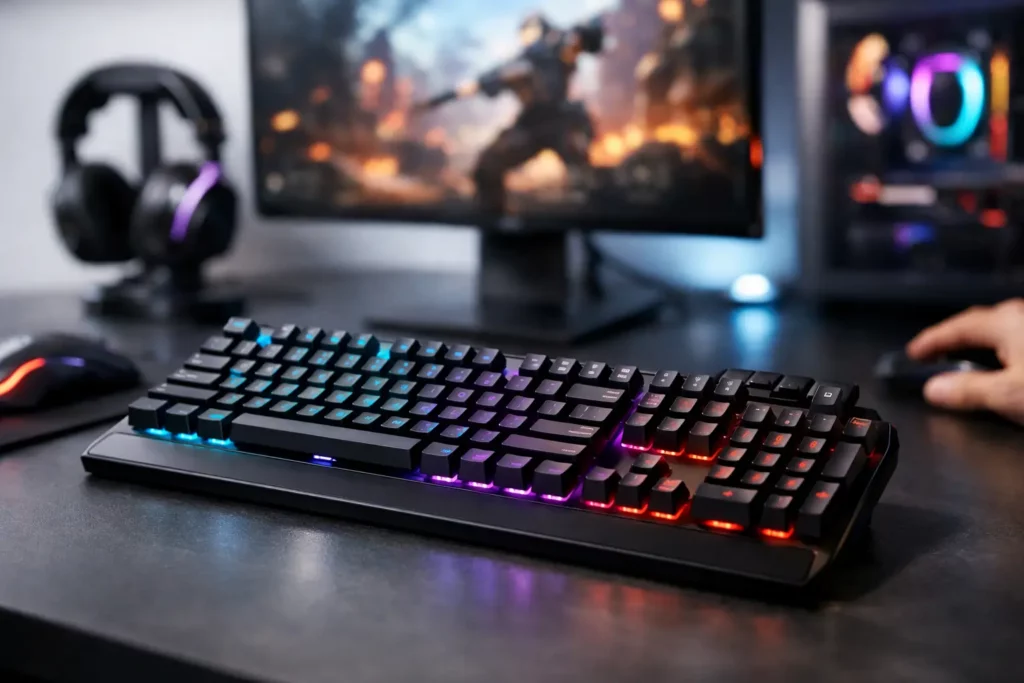
If your keyboard wishlist suddenly feels outdated, that is because gaming keyboard release news has gotten busy fast. New boards are showing up with magnetic switches, lighter wireless builds, gasket mounts, higher polling rates, and software features that were premium-only not long ago. For PC players who care about both performance and desk setup, the category is moving quicker than it did even a year ago.
That shift matters because gaming keyboards are no longer just about choosing between clicky, tactile, or linear. Brands are now competing on response tuning, switch customization, sound profile, battery life, and how well a board fits both ranked matches and everyday work. The result is a market that feels more exciting, but also a little harder to track if you are not following every announcement.
Why gaming keyboard release news feels hotter right now
A big reason is that the line between enthusiast mechanical keyboards and mainstream gaming gear keeps getting thinner. Features that used to live in custom keyboard circles, like hot-swap sockets, better stabilizers, foam layering, and more refined acoustics, are now appearing in gaming products from bigger brands. At the same time, gaming-first innovations like rapid trigger and adjustable actuation are pulling attention away from standard mechanical boards.
That has created a kind of arms race. Companies are not just launching refreshes with a new RGB pattern and calling it a day. They are trying to claim a real advantage, whether that means Hall effect switches for faster input control, slimmer low-profile designs for cleaner desks, or tri-mode wireless connectivity for players who move between gaming PCs, laptops, and tablets.
Pricing is part of the story too. The premium end of the keyboard market is still expensive, especially when brands stack aluminum cases, magnetic switches, and advanced software into one product. But more midrange launches are starting to borrow those same ideas. That makes current gaming keyboard release news more relevant even for buyers who are not shopping at the top of the market.
The biggest trends in gaming keyboard release news
The headline trend is still magnetic switch adoption. Hall effect keyboards have gone from niche talking point to one of the most visible features in the category. Brands are pushing adjustable actuation because it gives players more control over how much force or travel is needed before a key registers. For competitive games, especially shooters and rhythm-heavy titles, that promise is easy to market.
Rapid trigger is the other phrase that keeps showing up. It lets keys reset based on movement rather than a fixed point, which can make repeated directional inputs feel faster and more precise. For some players, that is a real benefit. For others, especially people playing mostly single-player games or using their keyboard more for mixed work and gaming, it may not change the experience enough to justify a premium price.
Wireless performance is also getting more serious. A few years ago, wireless gaming keyboards still carried a little skepticism, especially among players worried about latency or battery anxiety. That is fading. Recent launches are treating low-latency 2.4GHz wireless as standard rather than optional, and battery efficiency is improving even on boards that keep per-key RGB.
Form factor is another area where brands are getting sharper. Full-size boards are still around, but a lot of launch momentum is centered on 75 percent, TKL, and 65 percent layouts. That tracks with how people actually use their setups now. More players want room for wide mouse movement, cleaner cable management, and a desk that can switch from gaming to remote work without looking overloaded.
Then there is software, which remains one of the biggest make-or-break issues. A keyboard can have strong hardware and still lose people with clunky setup software, confusing profiles, or unreliable firmware updates. That is why new release coverage often focuses as much on customization tools as the switches themselves.
What brands are actually competing on now
The old pitch was simple: faster response, brighter RGB, stronger build. That still matters, but the competition is more layered now.
First, brands are fighting over feel. Sound and typing texture have become more visible selling points, even in gaming products. That means launches now talk about factory lubrication, dampening materials, stabilizer quality, and plate design in ways that would have sounded niche not long ago. Gamers who also spend all day typing for work are paying attention.
Second, they are fighting over flexibility. Hot-swap support, cross-platform compatibility, wired and wireless modes, and onboard profile storage all help a keyboard feel less locked into one use case. That matters for readers who want one board for gaming at night and productivity during the day.
Third, they are fighting over perceived future-proofing. If a new keyboard launches without some version of adjustable actuation or advanced input tuning, it can feel behind the curve even if the core experience is solid. That does not mean every buyer needs those features. It just means the market conversation has shifted.
What to watch before the next gaming keyboard launch
Not every flashy announcement deserves immediate upgrade hype. Some new boards genuinely push the category forward, while others mostly repackage features already available elsewhere.
One of the first things worth checking is the switch story. If a brand is emphasizing magnetic switches, the obvious follow-up is whether the implementation is actually useful or just headline bait. Adjustable actuation sounds great, but the software has to be stable and easy to tune. If settings are buried or inconsistent, the feature loses value fast.
Build quality is another easy place for marketing to get ahead of reality. A keyboard can look premium in launch photos and still ship with uneven stabilizers, hollow acoustics, or a flex pattern that feels cheaper than expected. Early impressions often reveal more than spec sheets here.
Battery life claims deserve a little caution too. Wireless numbers can vary a lot depending on polling rate, RGB brightness, and whether the board supports always-on features. If a launch announcement promises huge endurance, it is worth remembering that real use usually lands lower than the most flattering lab scenario.
Layout also matters more than many buyers expect. Compact boards are popular for good reason, but not everyone wants to give up function rows, dedicated arrow spacing, or a numpad. The smartest recent launches are the ones that clearly know who they are for instead of trying to please every type of user at once.
The upgrade question: buy now or wait?
This is where gaming keyboard release news gets tricky. If you have been holding off for the next big thing, the market will always give you another reason to wait. There is always a new switch, a new firmware feature, or a thinner wireless design around the corner.
If your current keyboard is frustrating you now, waiting for a perfect future option usually is not worth it. The category is maturing, but it is also fragmenting. The best board for an esports-focused player is not necessarily the best one for someone who wants great typing feel, long battery life, and a setup that looks clean in a small apartment office.
On the other hand, if you are specifically interested in Hall effect features, this is a reasonable time to stay patient for a bit longer. Competition is increasing, and that usually means more price pressure and better feature balance in the next wave of releases. Premium features rarely stay premium forever.
That is especially true in a market where gaming and lifestyle hardware keep overlapping. Keyboard launches are no longer just about raw play performance. They are also about aesthetics, portability, desk appeal, and how one device fits into a broader everyday tech setup. That broader framing is exactly why the category keeps showing up in the same conversation as monitors, audio gear, handhelds, and productivity accessories.
Where gaming keyboard release news goes next
The next stretch of launches will probably keep pushing three things at once: smarter switch tech, better wireless execution, and cleaner design. Magnetic switches are likely to spread further into the midrange, while premium brands will try to separate themselves with software refinement and build quality instead of specs alone.
There is also a decent chance that more brands lean into crossover messaging. Expect keyboards marketed not just for competitive gaming, but for creators, streamers, hybrid workers, and anyone building a setup that has to handle more than one role. That does not mean pure gaming boards are going away. It just means the sales pitch is broadening.
For readers trying to keep up without turning every product launch into a research project, the best move is simple: watch the features that change actual daily use, not just the ones that dominate announcement graphics. A keyboard that sounds better, feels better, and fits your setup is often a smarter buy than one that wins the spec war on paper.
The smart play now is not chasing every launch. It is knowing which new features are worth your money and which ones can wait for the next round.



More Stories
Gaming Showcase Recap Today: Biggest Reveals
OLED vs Mini LED Monitors: Which Wins?
Open Back vs Closed Headphones Explained