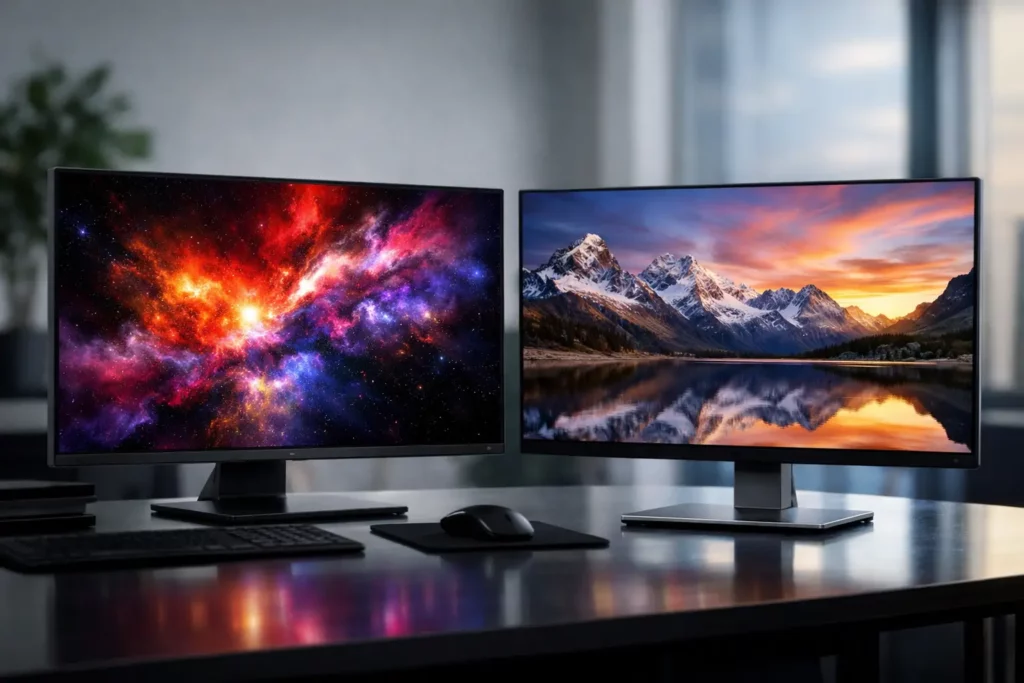
Picking between OLED vs mini LED monitors gets tricky fast because both can look seriously impressive, but they win in different ways. One is all about perfect blacks, instant response times, and that high-end wow factor. The other fights back with higher brightness, fewer long-term panel worries, and better value across more sizes.
If you mostly care about gaming, content consumption, or just making your setup look incredible, OLED can feel like the obvious flex. If you want a display that handles bright rooms, long workdays, and mixed use without making you think about burn-in, mini LED starts looking like the safer buy. That split is why this comparison matters right now – monitor makers are pushing both hard, and shoppers have more real options than ever.
OLED vs mini LED monitors: the core difference
OLED monitors use self-lit pixels. Every pixel can turn on or off individually, which is why OLED is famous for true blacks and near-infinite contrast. When a part of the screen should be black, those pixels simply shut off.
Mini LED monitors work differently. They still use an LCD panel, but the backlight is made up of far more, much smaller LEDs than traditional LED displays. That allows for much better local dimming, stronger HDR performance than standard LCDs, and much higher peak brightness in many cases. But because the image still relies on zones rather than pixel-level light control, black levels are usually not as precise as OLED.
That technical difference shows up immediately in everyday use. OLED looks cleaner in dark scenes and often more cinematic overall. Mini LED looks punchier in bright highlights and can hold up better when sunlight or overhead lighting is working against your screen.
Picture quality is where OLED still grabs attention
For pure contrast, OLED is hard to beat. Dark game scenes, sci-fi movies, horror titles, and anything with lots of shadow detail tend to look better on OLED. Blacks look black instead of dark gray, and bright objects against dark backgrounds pop without the hazy glow that can show up on dimming-zone displays.
That matters more than specs suggest. A monitor can have strong brightness numbers, but if black levels aren’t convincing, the image loses some depth. OLED usually nails that sense of depth right away, especially in a dark room.
Color performance is also a big part of the appeal. Many OLED monitors offer excellent color saturation and strong perceived vibrancy. Games and media can look richer without feeling cartoonish, though calibration still matters if you do serious creative work.
Mini LED is not bad here at all. In fact, some mini LED monitors look fantastic, especially premium models with lots of dimming zones. But side by side, OLED usually has the cleaner, more premium image in darker content.
Mini LED fights back with brightness
This is where mini LED monitors can make a very strong case. Brightness is not just about eye-searing highlights in HDR demos. It also affects how usable a monitor feels during the day, in offices, bedrooms with open blinds, or any space where lighting is less controlled.
Mini LED panels often hit much higher sustained and peak brightness than OLED monitors. That can make HDR highlights stand out more aggressively, especially in explosions, reflections, sunlit scenes, and bright UI-heavy games. If you play in a bright room, mini LED’s extra output can matter more than OLED’s perfect black levels.
OLED brightness has improved, but it still comes with trade-offs. Some OLED monitors look amazing with small HDR highlights, then feel less impressive when large bright areas fill the screen. That’s because brightness behavior can vary depending on the panel and how much of the display is lit up at once.
So if your setup lives in a room that never gets dark, mini LED starts to look less like the compromise and more like the smarter fit.
For gaming, both are good – but not for the same reasons
Gamers are a huge reason this debate keeps heating up. OLED has a real edge in motion clarity and response times. Fast shooters, racing games, and anything where ghosting ruins the vibe tend to feel exceptional on OLED. Motion looks cleaner, transitions are faster, and the whole experience feels premium in a way that’s hard to fake.
Input lag on modern gaming monitors is low across the board, but OLED’s pixel response is still one of its strongest cards. If you’re chasing smoothness, especially at high refresh rates, OLED has earned the hype.
Mini LED can still be excellent for gaming, especially if you want high refresh rates plus strong HDR brightness. Some mini LED monitors are more versatile if you split time between competitive gaming and everyday desktop work. You also avoid the background anxiety some users get with static HUD elements, minimaps, taskbars, and long Discord sessions sitting on screen for hours.
That’s the real gaming split. OLED often delivers the more exciting experience. Mini LED often delivers the easier one to live with every day.
Burn-in is still part of the OLED conversation
Yes, OLED burn-in is still worth talking about. No, it’s not always the deal-breaker some people make it out to be.
Modern OLED monitors include protections like pixel shifting, panel refresh features, logo dimming, and screen savers. Those tools help. Panel tech has also improved. But risk is not zero, especially for people who use their monitor for long stretches of static content like spreadsheets, editing timelines, browser tabs, and Windows taskbars.
If your monitor is mainly for games and media, OLED risk is easier to manage. If it doubles as an 8-hour-a-day work display with the same UI elements always visible, mini LED feels a lot less stressful.
That doesn’t mean mini LED is flawless. Some models show blooming around bright objects on dark backgrounds because local dimming zones can’t match per-pixel lighting. You may notice halos around subtitles, mouse cursors, or HUD elements depending on the monitor. It’s not always severe, but it’s one of the biggest quality trade-offs versus OLED.
OLED vs mini LED monitors for work and mixed use
If you need one monitor for everything, this decision gets more practical fast. OLED is incredible for entertainment and gaming, but text rendering and long-term desktop use can be a mixed bag depending on the panel layout and your sensitivity to it. Some users love OLED for all-day use. Others notice text fringing or feel uneasy about static UI wear over time.
Mini LED is often the more comfortable all-rounder for office work, browser-heavy use, and productivity. You still get a big visual upgrade over standard IPS displays, especially in HDR-capable models, but without the same level of image retention concerns.
This is where a lot of buyers land: OLED as the dream gaming and media display, mini LED as the more practical daily driver. If your setup has to handle both work and play equally, mini LED may fit your life better even if OLED looks cooler in screenshots.
Price matters, and mini LED usually has the easier pitch
OLED monitor prices have come down, but they still sit in premium territory more often than not. If you want high refresh rates, ultrawide formats, or newer panel generations, the price can climb fast.
Mini LED monitors cover a wider range. There are expensive flagship options, but there are also more approachable models that still deliver meaningful HDR and strong brightness. That makes mini LED easier to recommend for buyers who want a clear upgrade without fully entering luxury-monitor territory.
Value also depends on how long you plan to keep the display. If you upgrade often and want the best image today, OLED can make sense. If you want one monitor to do years of mixed use with fewer maintenance worries, mini LED can be the smarter spend.
Which one should you actually buy?
Go OLED if your priority is top-tier contrast, elite gaming response, and a screen that makes movies and games look ridiculous in the best way. It’s the enthusiast pick, especially for dark-room setups and players who want image quality that instantly stands out.
Go mini LED if you want stronger brightness, better daytime usability, fewer worries about static content, and more flexibility for work-plus-gaming setups. It’s often the easier recommendation for people who need one monitor to do everything well.
There isn’t one universal winner in OLED vs mini LED monitors. There’s the better fit for how you actually use your screen. If your setup leans entertainment-first, OLED still feels like the headline grabber. If your screen has to survive the full chaos of gaming, work, streaming, and daily desktop life, mini LED may be the move that ages better.
The best monitor is the one that matches your room, your habits, and the stuff you actually do every day – not just the one that looks best on a spec sheet.


More Stories
Gaming Showcase Recap Today: Biggest Reveals
Open Back vs Closed Headphones Explained
Gaming Keyboard Release News to Watch