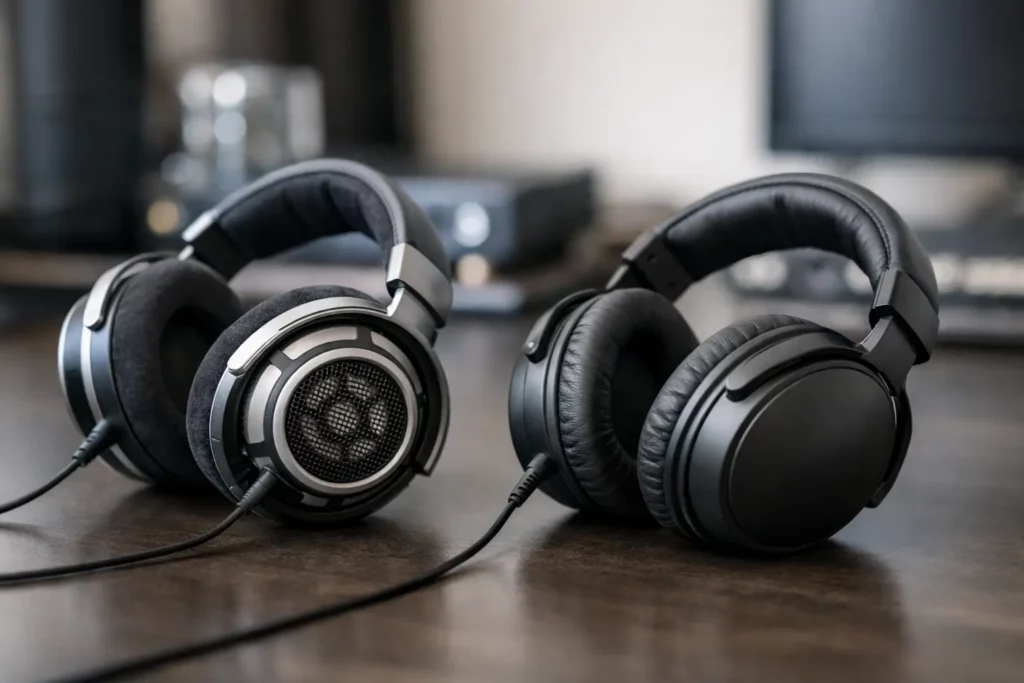
You notice the difference between open back vs closed headphones fast – usually the first time a game world feels huge, or the first time outside noise ruins a great track. This choice shapes how your audio feels in real life, whether you’re grinding ranked matches, editing video, working from home, or just trying not to annoy everyone nearby.
A lot of buyers treat this like a simple spec check. It really isn’t. Open-back and closed-back designs can change immersion, comfort, privacy, and even how long you want to keep a headset on.
Open back vs closed headphones: the core difference
The big split is in the ear cup design. Open-back headphones have vents or grills that let air and sound pass in and out. Closed-back headphones seal the back of the driver, keeping more sound contained.
That one design decision affects almost everything. Open-back models usually sound wider and more spacious. Closed-back models usually block more outside noise and keep your audio from leaking into the room.
Neither is automatically better. The right pick depends on where you listen, what you play, and whether you care more about immersion or isolation.
Why open-back headphones feel bigger
Open-back headphones are popular with PC gamers, music fans, and people who want a more natural presentation. Because the ear cups are vented, sound doesn’t feel boxed in the same way it often does with closed designs.
That usually creates a wider soundstage. In plain English, audio feels like it has more room to breathe. Environmental effects in games can seem more convincing, live recordings can sound more open, and directional cues may feel easier to place.
This is a big reason open-back models get so much hype in enthusiast circles. If you play immersive single-player games, open-world titles, or competitive shooters where positioning matters, that airy presentation can feel like a real upgrade.
There’s also a comfort angle. Open-backs often stay cooler over long sessions because they let heat escape more easily. If you spend hours at your desk, that can matter as much as sound quality.
The catch is obvious once you leave a quiet room. Open-back headphones leak sound outward, and they let outside noise in. If a fan is running, someone is talking nearby, or traffic is coming through the window, you’re going to hear it.
Why closed-back headphones fit more people
Closed-back headphones are the default for a reason. They’re easier to use in more places and with fewer compromises. The sealed design helps isolate you from your surroundings and prevents your audio from spilling out as much.
That makes them a better match for commuting, offices, shared spaces, dorm rooms, and basically any setup where privacy matters. If you’re gaming in the same room as other people, taking calls, or tracking audio with a mic nearby, closed-backs are usually the safer move.
They also tend to deliver more perceived impact in the low end. Bass can feel punchier and more immediate because the design contains sound rather than letting it disperse. For action games, electronic music, and movie watching, a good closed-back pair can feel more intense.
The trade-off is that some closed-back headphones can sound narrower or more enclosed compared to a strong open-back set. That doesn’t mean they sound bad. It just means the presentation is often more intimate and less expansive.
Heat buildup can also be worse during long sessions, especially with thicker pads and tighter clamping force. If you’ve ever taken off a headset after two hours and felt your ears needed fresh air immediately, you already know the downside.
Which one is better for gaming?
For gaming, it depends on the kind of experience you want.
If you mostly play at a desk in a quiet room, open-back headphones can be fantastic. They tend to make game audio feel more spacious, and that can help with immersion in RPGs, adventure games, and shooters. Footsteps and directional audio may feel easier to separate, though tuning matters just as much as the back design.
If your environment is noisy, closed-back headphones make more sense. A wider soundstage doesn’t help much if your AC unit, keyboard chatter, or TV in the next room keeps breaking your focus. Closed-backs give you a more controlled listening environment, which can be better for competitive play in real-world conditions.
There’s also the microphone factor. If you use a standalone mic or stream regularly, open-back leakage can be annoying. Closed-back headphones reduce the chance of your mic picking up game audio or chat bleed.
For most gamers, the practical split is simple: open-back for quiet, dedicated setups; closed-back for shared, noisy, or mixed-use setups.
Open back vs closed headphones for music
Music is where personal taste starts to matter a lot.
Open-back headphones often shine with genres that benefit from space and separation. Acoustic tracks, jazz, classical, live recordings, and layered soundtracks can feel more natural and less confined. If you like hearing subtle placement and air around instruments, open-backs are easy to love.
Closed-back headphones usually work better when you want energy, isolation, and consistency across different environments. Pop, hip-hop, EDM, and bass-heavy playlists often hit harder on a good closed-back pair. And if you listen on the go, the choice is almost made for you already.
The key thing is this: open-back headphones may sound more realistic in the right room, but closed-back headphones are more reliable in everyday life.
For work, calls, and daily use
This is where closed-back headphones usually pull ahead.
If you’re taking meetings, working around other people, or moving between devices and rooms, closed-backs are just easier to live with. They keep distractions down and avoid turning your playlist or call audio into shared office content.
Open-backs can still be excellent for home office use if your space is quiet and private. They’re often more comfortable for long stretches, and some people find the less pressurized feel easier on the ears over a full workday.
But if you need one pair to handle gaming, Zoom calls, travel, and casual listening, closed-back is the more flexible option by a wide margin.
Sound quality is not just about open or closed
This part gets lost in the debate all the time. Open-back vs closed headphones is important, but it is not the whole story.
Driver quality, tuning, ear pad material, weight, clamp force, impedance, and build all matter. A mediocre open-back pair will not automatically beat a well-tuned closed-back model. Likewise, some premium closed-backs sound impressively spacious, and some open-backs can feel thin if they’re not tuned well.
Price matters too. At lower price points, you may see bigger compromises in build or tonal balance. At higher tiers, the differences become more about presentation and intended use than raw quality.
So if you’re shopping, don’t stop at the back design. Think about the actual sound signature you like and the environment where you’ll use them most.
The easiest way to choose
If your setup is mostly at home, your room is quiet, and you care about immersion, comfort, and a wide presentation, open-back headphones are probably the move.
If you need privacy, isolation, stronger versatility, or a headset that works in more situations, closed-back headphones are usually the better buy.
If you’re stuck between the two, ask one question: what problem are you trying to solve? If your current headphones feel cramped and lifeless in games or music, open-back might be the upgrade you’re chasing. If you’re tired of hearing everything around you, or everyone around you can hear your audio, go closed-back and don’t overthink it.
There’s no universal winner here, which is why this debate never really goes away. One type is built to make audio breathe. The other is built to make audio behave.
That’s really the whole decision. Pick the one that fits your room, your routine, and the way you actually listen – not just the one that wins the loudest arguments online.



More Stories
Gaming Showcase Recap Today: Biggest Reveals
OLED vs Mini LED Monitors: Which Wins?
Gaming Keyboard Release News to Watch